Issue
71
Marty Supreme
- Director:Josh Safdie|
- Screenwriter:Josh Safdie, Ronald Bronstein|
- Distributor:A24|
- Year:2025
Professionals can hit a ping pong ball 70 miles per hour, which is roughly the speed at which Josh Safdie directs a movie.
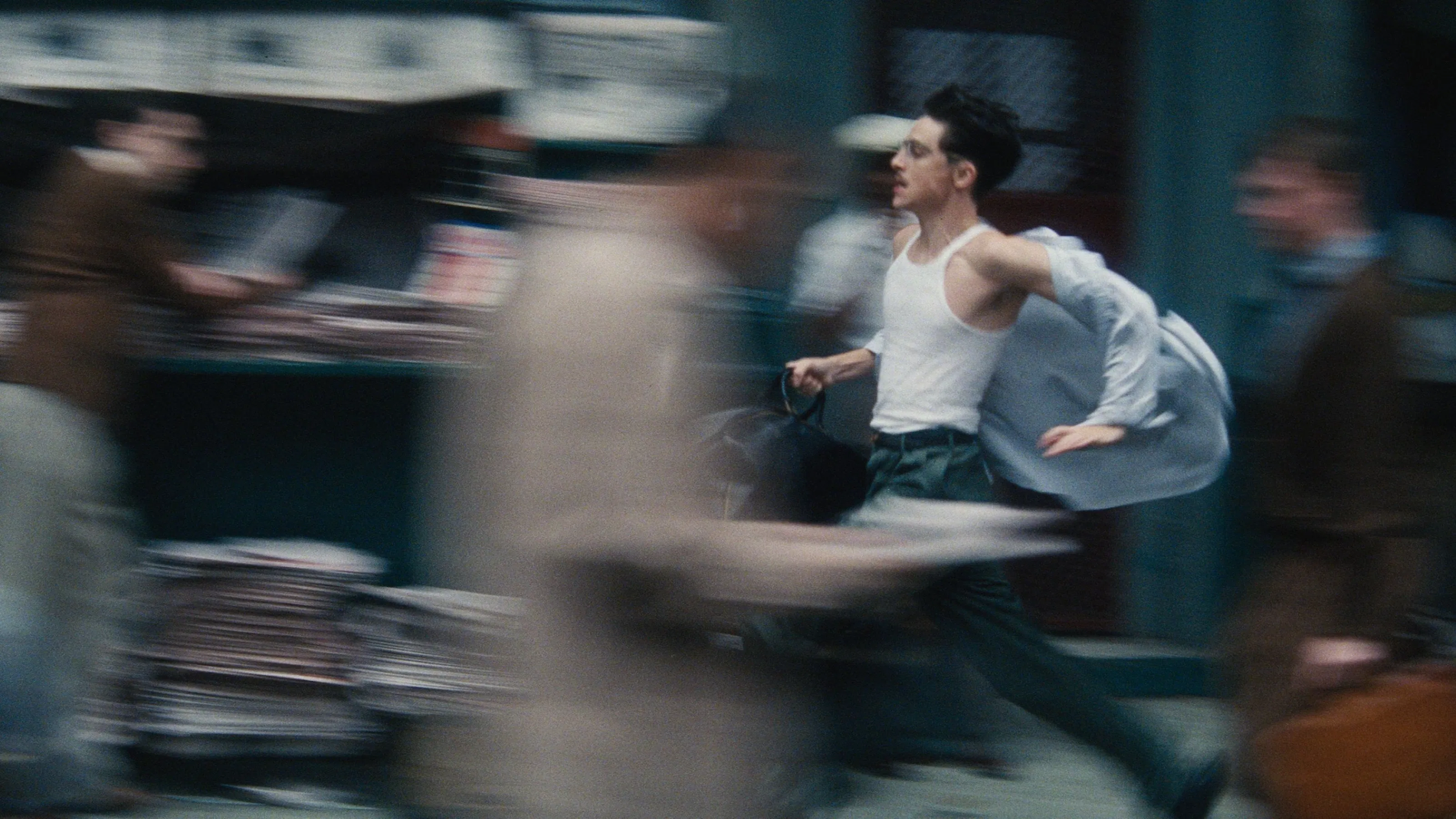
In pulse-raisers like Good Time and Uncut Gems, which he co-directed with his brother Benny, the elder Safdie sibling suffused a frenetic energy into every frame and lent the proceedings a jittery momentum that was thrilling and stressful in equal measure. Marty Supreme is as fast-paced and kinetic as table tennis itself, but the nervous energy of Safdie’s prior work has been channeled into something more focused and fully realized in his first solo directorial effort since 2008. The result is the best movie he’s ever made, a 1950s period piece that feels propulsively forward-thinking and of the moment.
Part of that is thanks to the anachronistic soundtrack. Bookended by ‘80s classics “Forever Young” and “Everybody Wants to Rule the World,” Marty Supreme features an original score by electronic artist and frequent Safdie collaborator Daniel Lopatin. The music is warm and hopeful, two adjectives with which you’d be hard-pressed to describe any other Safdie movie. In applying his usual approach to something ostensibly banal — ping pong isn’t exactly considered as intense as boxing — Safdie has found a sweet spot between subject and style.
Aspiring world champion Marty Mouser is sly, cunning, and frustratingly assured of his own greatness; he’s also oddly charming in a way that he wouldn’t be without the verve and charisma of Timothée Chalamet’s committed performance. Already a two-time Oscar nominee and surely about to be a three-timer, the 29-year-old is as devoted to the pursuit of greatness as his character — he’s just more tactful about it. Though loosely based on actual table-tennis pioneer Marty Reisman, “Mouse” is a capital-c Character whom you couldn’t imagine existing outside of a movie like this.
That might be a good thing. In an early scene, Marty, who’s Jewish, shows just how confident he is when he refers to himself as “the ultimate product of Hitler’s defeat” while being interviewed ahead of a crucial tournament in London. He can be abrasive, but he’s usually funny at the same time: “You struck a nerve, I struck a nerve,” he half-apologizes after saying something wildly offensive, “Now we’re even, okay?” In moments big and small, Chalamet is brilliant in his embodiment of this devil-may-care attitude that may or may not be a front for deeper, less secure feelings lurking beneath.
He doesn’t do it alone. Gwyneth Paltrow, in her first performance since she went on a post-Avengers hiatus in 2019, provides a memorable reminder of how she became so acclaimed in the first place. The two of them are backed by a bizarrely eclectic supporting cast that includes Shark Tank star Kevin O’Leary, Fran Drescher, Tyler the Creator, and iconic NYC filmmaker Abel Ferrara. No less pleasingly strange are a number of non-sequitur moments that add texture and character, like a Holocaust survivor’s flashback involving honeybees and a subplot about an unsavory figure’s missing dog. There’s no shortage of hijinks in Marty Supreme, some of them mildly anxiety-inducing but most of them thrilling and even darkly funny in their off-the-wall brio.
In applying his usual approach to something ostensibly banal, Safdie has found a sweet spot between subject and style.
Marty Supreme is a sports drama, but only just. There’s no training montage, zero mention of how or why Marty first became passionate about table tennis, and no information about the game’s surging popularity. When we meet Marty, he’s already one of the best players in the world; even after suffering a stinging defeat in the final round of that tournament, he doesn’t do any soul-searching or consider the possibility that his dreams won’t be realized. Most of the film concerns his efforts to redeem himself at the world championship, which he can only do if he’s able to raise enough money to travel to Tokyo. Along the way, he’ll get involved with a former movie star several decades his senior (Paltrow), develop an orange ping pong ball that’s easier to track at high speeds, and decide whether he’s ready to be a father after his married inamorata (Odessa A’zion) tells him she’s pregnant.
A lot of filmmakers can make a movie about a major historical figure feel important. Fewer can take inspiration from a relative unknown and make a movie loosely based on him feel just as urgent as a biopic. Marty’s dreams often collide with reality as he attempts to hustle his way back to the world championship, but he refuses to stop believing for a second that he’ll attain his goals. Most of his personality traits aren’t to be emulated, but that one is.