Issue
89
Two Seasons, Two Strangers
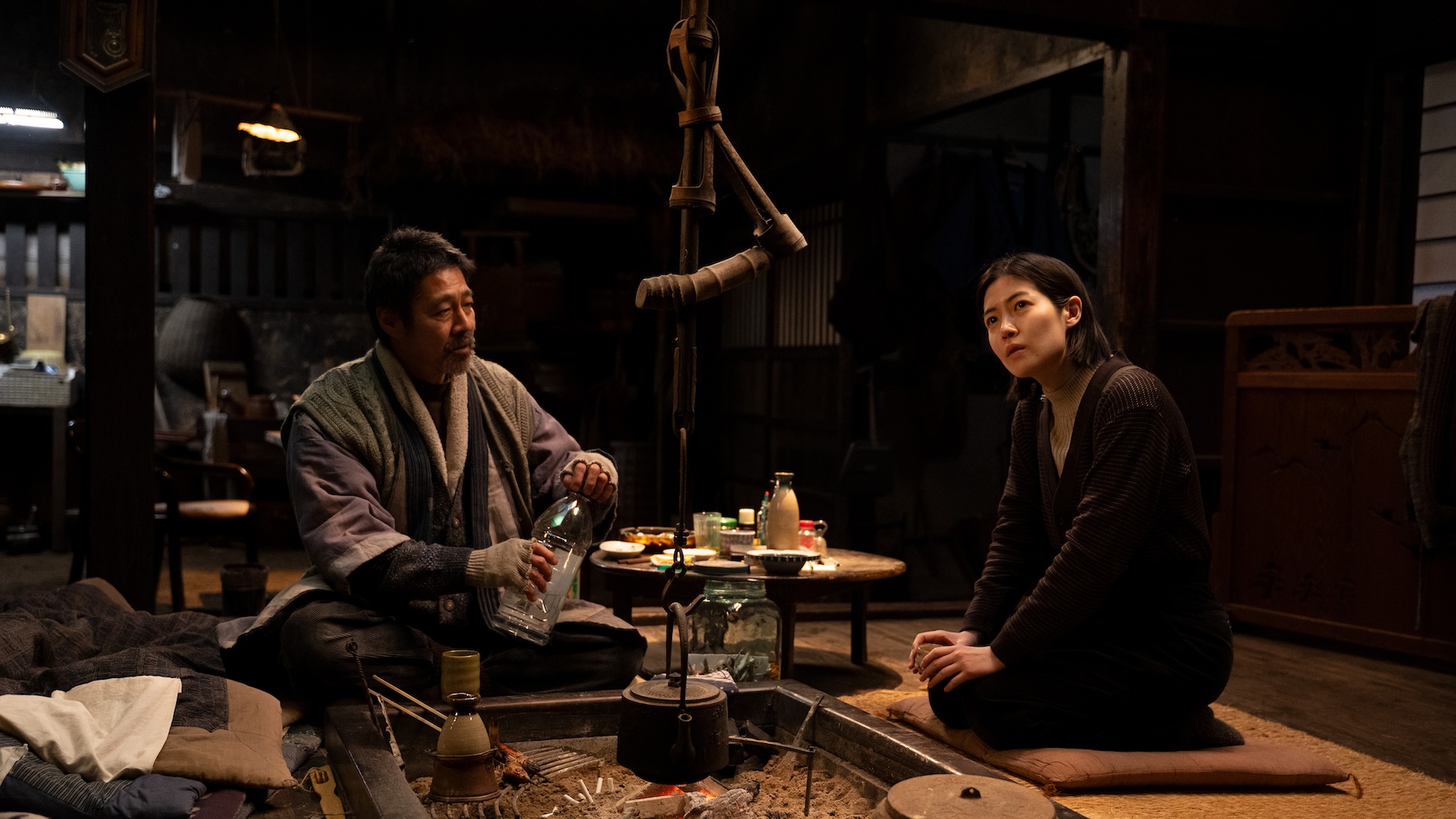
- Director:Sho Miyake|
- Screenwriter:Sho Miyake|
- Distributor:Several Futures|
- Year:2025
Two Seasons, Two Strangers begins as all movies do: on a blank page.
It’s just that we usually don’t see the blank page itself once the movie has been written, filmed, and released. The scribe in question is Li (Eun-kyung Shim), a Korean expat whose career has taken her to Japan and who apparently prefers pencil and paper to screenwriting software. Writer/director Sho Miyake’s latest quiet, gentle character study alternates between the story Li’s writing and the life she’s living, which are, per the title, mirror images of one another. Based on “A View of the Seaside” and “Mr. Ben and His Igloo,” two short stories by revered manga artist Yoshiharu Tsuge that are unconnected yet dovetail beautifully onscreen, Two Seasons, Two Strangers is quite literally more than the sum of its interwoven parts.
As soon as Li overcomes her initial writer’s block, we see her script come alive. It’s summer in a nameless seaside town, where Natsuo (Mansaku Takada) is visiting relatives when he meets a young woman named Nagisa (Yuumi Kawai) on the beach. Small talk quickly gives way to waxing philosophical as the two of them discuss everything from whether boredom fosters imagination or depression to how long it might take to swim to the horizon.
It’s not entirely unlike a Japanese take on Before Sunrise, only the walk-and-talk action is less overtly romantic and whatever longing exists between them goes unfulfilled. Two Seasons, Two Strangers is about loneliness, yes, but it’s also about simply navigating the world as an introvert: wanting to form connections with people while also being reticent to put yourself out there lest you give away too much of yourself.
Miyaki frequently switches between the screenplay and the story it’s telling, with the one preceding the other — we know from Li’s handwritten script that “the young man feels uncomfortable and leaves the beach” before we actually see it happen. There’s an ASMR-like quality to her pencil strokes, which bring an analog warmth to the proceedings. Just before Natsuo and Nagisa’s brief encounter meets its watery end, we’re brought back to Li’s world as a screening of her unnamed film concludes and she takes part in a Q&A with a group of students. Asked how it feels to see her work onscreen, Li can’t help but be honest: “It makes me think that I don’t have much talent.”
Two Seasons, Two Strangers’ arrival in theaters is preceded by a festival run that saw it earn the Golden Leopard at the Locarno Film Festival in addition to being named the best Japanese film of 2025 by Kinema Junpo, the country’s oldest and most prestigious film magazine. It was the second straight year Miyake won the award, having also taken it home for 2024’s All the Long Nights; he’s been acclaimed both domestically and on the international film-festival circuit for well over a decade, yet this is the first of his movies to be released in the U.S. One hopes this brings more eyes to his previous work, especially the unusually gentle boxing drama Small, Slow but Steady, the title of which doubles as an encapsulation of his sneakily effective filmmaking philosophy.
Two Seasons, Two Strangers is quite literally more than the sum of its interwoven parts.
The rest of the movie follows Li to a snowbound inn run by a lonely man named Ben-zō (Shinichi Tsutsumi) as she struggles to work on her next screenplay. (Asked what it’s about, she sheepishly, hilariously admits “ninjas.”) Their dynamic is not unlike that of Natsuo and Nagisa, informed as it is by a similar kind of melancholy that feels most pronounced in the presence of a kindred spirit. He thinks he should make the inn the subject of her new script, which leads her to ask him questions he’d rather not answer — like why he’s alone here when this kind of lodging is usually family-run.
None of this is as dour as it might sound. Miyake finds all manner of small yet stirring moments of connection between his characters, whose souls are wandering yet not quite lost. Fittingly for a movie about a writer, Two Seasons, Two Strangers is also highly quotable. Characters frequently dispense wise observations like “maybe travel is about trying to get away from words,” the cumulative effect of which is, of course, about much more than writing. Maybe some movies are about trying to get away from words, too — aren’t the best movies those you find hardest to describe, after all?