Issue
97
Disclosure Day
- Director:Steven Spielberg|
- Screenwriter:David Koepp|
- Distributor:Universal Pictures|
- Year:2026
What a gift Steven Spielberg is.
More than a half century into his singular career, he’s still operating at a level that would make the countless filmmakers he’s inspired to follow in his footsteps blush. Disclosure Day, his most Spielbergian movie in decades, is a summer blockbuster as only the genre’s progenitor could direct: an escapist entertainment that doesn’t require you to turn off your brain but will occupy it well after the credits roll on a note-perfect final scene.
For decades, the conventional wisdom has been that Spielberg makes two kinds of movies: popcorn flicks in the vein of Jaws and Jurassic Park and prestige pictures in the Schindler’s List and Saving Private Ryan mold. The truth is that the line between the two has always been porous, as Spielberg excels at imbuing even his high-concept fare with high-minded ideas that most of his peers wouldn’t bother with. Disclosure Day exists smack dab in the middle of that spectrum, combining the best of both modes into something extraordinary. Like Close Encounters of the Third Kind, it’s about our place in the universe and how the existence of aliens completely upends everything we know about, well, everything; like The Post, it’s about the importance of sharing vital information with the public, even and especially if the powers that be want it kept secret.
It begins with cybersecurity expert-turned-whistleblower David Kellner (Josh O’Connor) eluding his superiors at Wardex, a shadowy corporation that has helped the government keep the truth about aliens from going public for nearly 80 years. David, who had a change of heart about his line of work after watching a particularly disturbing video, thinks the truth — all of it, all at once — belongs to everyone. His girlfriend Jane (Eve Hewson), a former novitiate who still wears a cross, worries about the theological implications of these revelations: how will people who’ve spent their lives worshipping a supreme being react to the existence of what some of them might consider actual supreme beings?
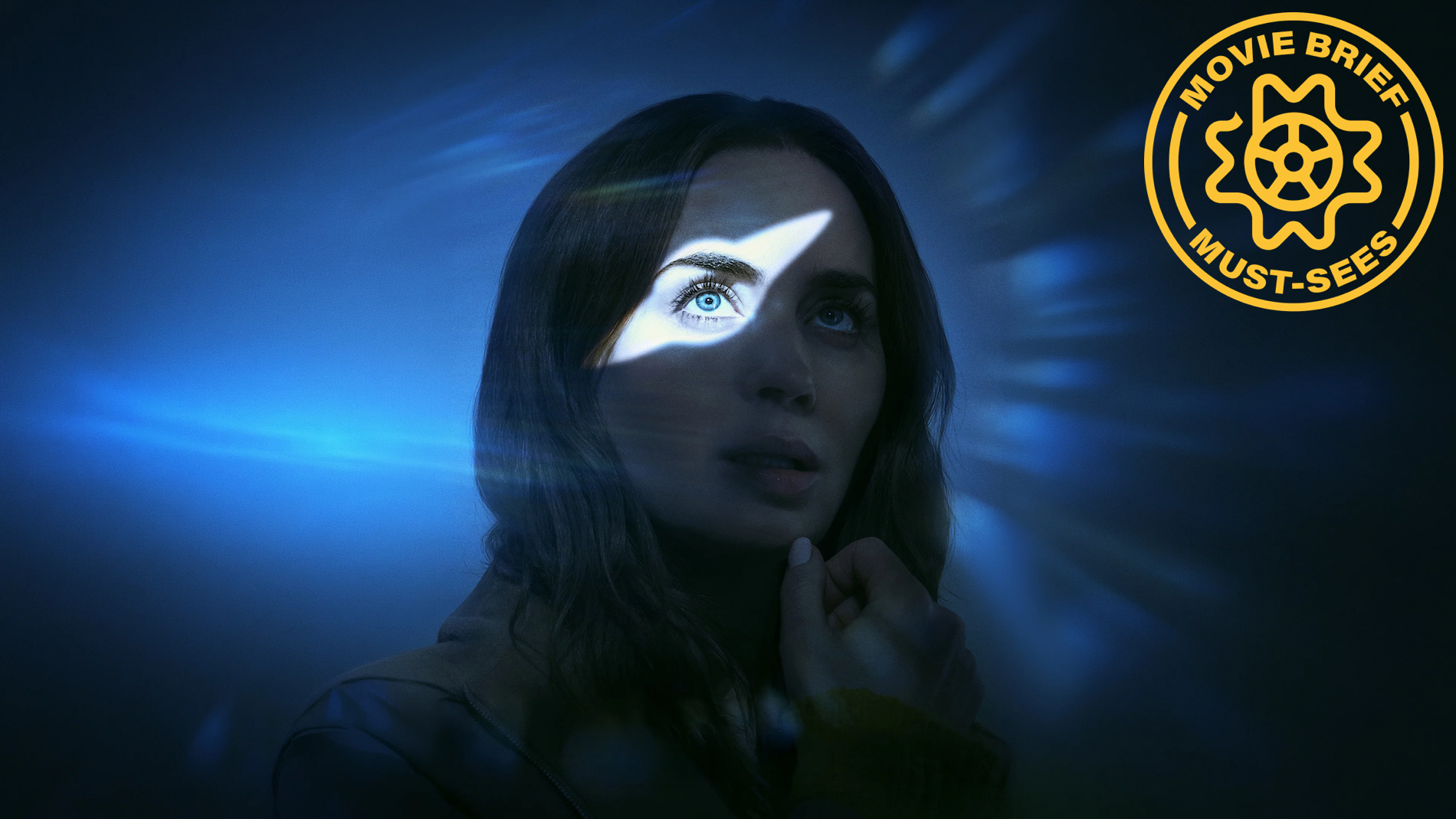
The other half of this extraterrestrial equation is Margaret Fairchild (Emily Blunt), a TV meteorologist from Kansas City who finds herself imbued with psychic abilities after a cardinal flies into her window and shares the briefest of moments with her before being shooed away by her boyfriend. All of a sudden she can speak Russian and knows nearly everything about a person just by looking at them, gifts she can neither control nor understand. She, too, draws the attention of Wardex when she appears to enter a fugue state and speak gibberish while presenting the weather — except the bizarre clicking sounds she’s making aren’t gibberish at all.
Blunt is superlative even by her standards in what might be the standout performance of her career, portraying Margaret as both an unwitting vessel and a deeply sympathetic heroine whose attempt to understand what’s happening to her is one and the same with helping the world understand what’s happening to it. In one of several deeply emotional scenes, she peacefully evades capture by appearing to a dozen different Wardex agents as departed or estranged loved ones and telling them something that only that person would know.
Here and elsewhere the film moved me, first to the edge of my seat and then to tears as it revealed the depth of its message — which, like the one David and Margaret mean to share with the world, deserves to be broadcast far and wide. Much of Disclosure Day’s plotting is predicated on the idea that mathematics is the universal language, but I think movies are. If we were to follow the Voyager Golden Records by sending a selection of films that demonstrate who we are as a species into space, this one wouldn’t be out of place.
This is a summer blockbuster as only the genre’s progenitor could direct.
I sometimes joke that my favorite genre is Movies About the Truth and Beauty of the Universe, only it’s not really a joke. There are just so few movies that qualify that it’s less a genre and more a description of what I think more movies should aspire to do: look at the cosmos through a telescope in order to put the human condition under a microscope. Disclosure Day does all that and more. Even if it doesn’t resonate as deeply with you as it did with me, I can’t imagine moviegoers not being wildly entertained by the spontaneous crop circles, telepathic interrogations, and a dangerously powerful device of extraterrestrial origin known only as, well, the device.
This is sci-fi of the Close Encounters, Contact, and Arrival kind, a movie not about what aliens would do if they wanted to harm us but what they would do if they wanted to teach us — about ourselves, themselves, and the universe of which we’re all an equally significant part. That it was conceived and directed by a filmmaker without a cynical bone in his body makes it all the more special. (The other former Wardex employee assisting Daniel, played by Colman Domingo, at one point refers to empathy as an “evolutionary advantage.”) Disclosure Day is yet another example of exactly why Spielberg is the measuring stick for classical studio filmmaking, delivering two broad, accessible hours of cinematic escapism without dumbing down longtime collaborator David Koepp’s script or condescending to viewers. Unlike Jane, Spielberg never worries that we can’t handle the truth.
This is the kind of movie we go to the movies for, and somehow over the last few decades it’s also become a rarity: an original story that aspires not to start a franchise but to remind us what makes sitting down in a packed theater so vital an experience in the first place. Anyone still unsure whether it’s worth their time should follow the advice of the one alien message we actually see interpreted: “Don’t be afraid of what you don’t know.”