Issue
105
Colony
- Director:Yeon Sang-ho|
- Screenwriter:Yeon Sang-ho, Choi Gyu-seok|
- Distributor:Well Go USA Entertainment|
- Year:2026
Just when you thought you’d seen every kind of zombie, along comes Colony to introduce a new variant.
Call them the quadruped undead: zombies who run on all fours at breakneck speed and, even more terrifyingly, think and act as one. It figures that Train to Busan director Yeon Sang-ho would be the one to contribute something new to a genre that always seems on the verge of life support. His and co-writer Choi Gyu-seok’s updated undead function as a kind of hivemind with collective intelligence: when one of them learns something new about their prey, they all do. If only more movies were as smart.
Unfolding over a single night in a Seoul high-rise with a shopping mall on its lower levels, Colony pits the usual ragtag group of survivors against the infected. The real antagonist, though, isn’t one of those zombies but rather their mad-scientist creator: Seo Young-cheol (Koo Kyo-hwan), who believes that “imperfect communication” is the cause of most of life’s tragedies and wants to eliminate it from the human race — never mind that doing so will likely eliminate the human race along with it. The first victim is the CEO of a bioscience company, whom Young-cheol believes wronged him in the past.
The survivors — including professor Kwon Se-jeong (Jun Ji-hyun), her ex-husband (Go Soo), a security guard at the building where the outbreak occurs (Ji Chang-wook), and his wheelchair-bound sister (Kim Shin-rok) — are as clever and resourceful as the movie itself, and part of what makes Colony a worthy addition to the zombie canon is that it doesn’t treat its characters as mere cannon fodder. We instantly like and care about them more than most soon-to-be infected, especially Se-jeong and the brother-sister pair; the fact that we actively want them to survive instantly places Colony above many of its genre peers.
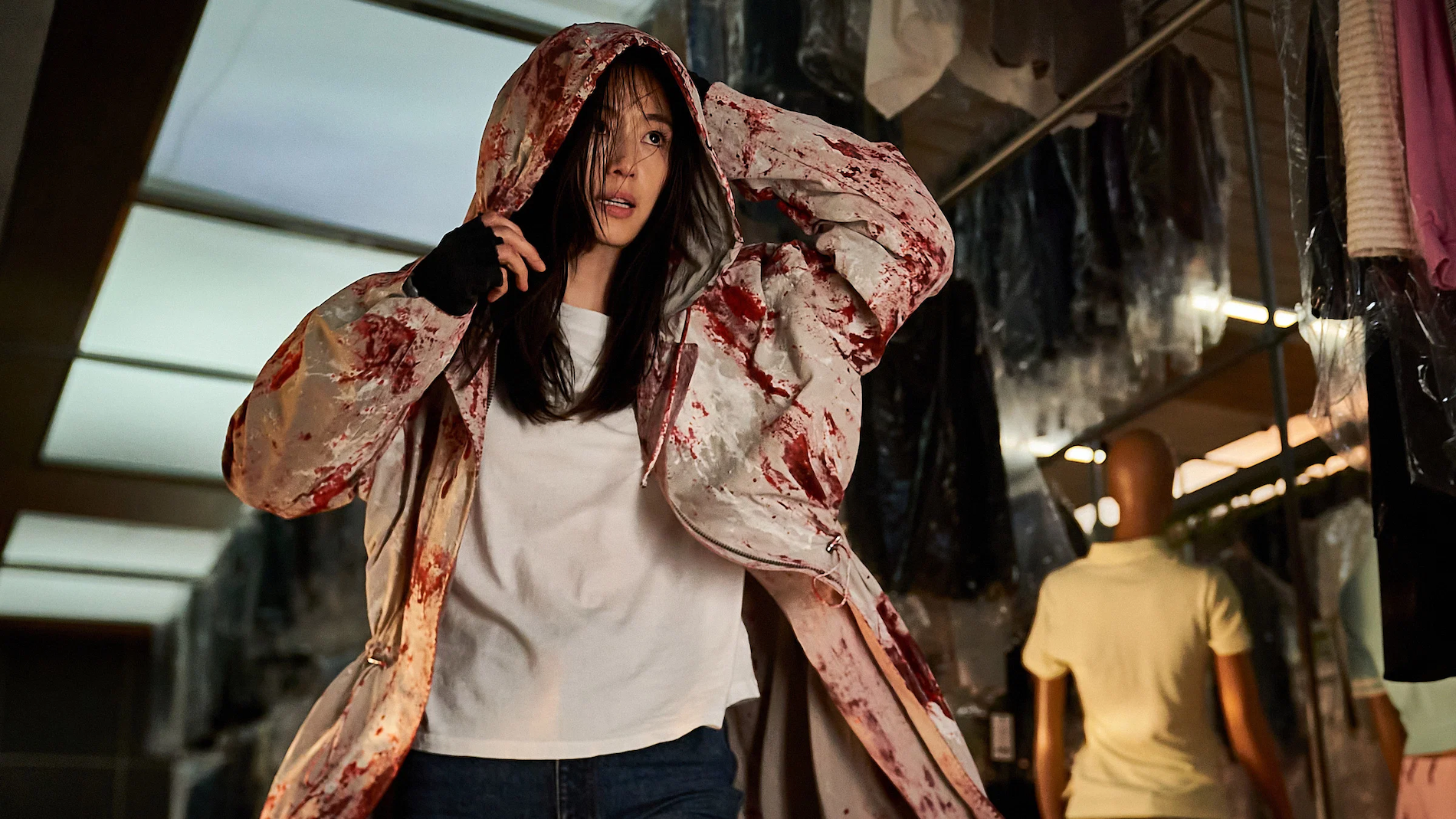
Led by Se-jeong, who was there to meet with the CEO about a job opportunity, the group quickly adapts to the zombies’ own adaptations — try not to be impressed as Se-jeong masterminds a plan to use perfume to literally throw the undead off their scent and attack mannequins instead. It’s like a group-project science experiment in which she comes up with the hypothesis and the rest of the team performs enough field research to share credit.
Unfortunately for them, the zombies are hardly brainless. After watching the security guard carry his sister on his back, they follow suit and form three-headed monstrosities while contorting like breakdancers. Every time one of them processes new information, the rest of them look straight up and go dormant for a moment while essentially downloading said info. Instead of vomiting blood, as has become de rigueur in the genre, they spit up a white, foamy substance reminiscent of Ridley Scott’s famed robot milk. Why do they do this? Yeon never explains, instead following the rule of cool and allowing the gory visuals to speak for themselves.
When one of them learns something new about their prey, they all do. If only more movies were as smart.
The director has been chasing the Train to Busan high for a full decade now, with both an animated prequel (Seoul Station) and live-action sequel (Peninsula) failing to reach the heights of that international sensation. South Korea has had an outsize presence in the entertainment landscape during that time, with everything from Parasite and Squid Game to KPop Demon Hunters and Blackpink contributing massively to the country’s status as a pop-culture superpower. Colony, which is more action than horror, is a welcome return to form for Yeon, albeit one less likely to become a global hit.
That much of the action takes place in a mall is a clear throwback to the genre’s high-water mark, George Romero’s Dawn of the Dead, traces of whose cleverness can be seen in bits and spurts here. Rather than comment on the mindless nature of consumerism, though, Yeon and Choi draw subtle connections between the living and the not-quite-living in other ways. When the survivors start communicating via group chat, for instance, it’s hard not to think of it as a corollary to the zombies’ own form of nonverbal messaging. Who’s to say which method of communication is less imperfect?