Issue
109
Never After Dark
- Director:Dave Boyle|
- Screenwriter:Dave Boyle|
- Distributor:Magnolia Pictures|
- Year:2026
Is it possible to commit an act so horrible you become a ghost before you die?
That’s the question at the heart of Never After Dark, a haunted-house story made in Japan by an American filmmaker whose sensibilities are as informed by Pulse as they are by The Changeling. If the way we live determines the way we die, as writer/director Dave Boyle’s understated chiller suggests, then many unlucky souls can expect to be caught in a purgatorial in-between — including, perhaps, Airi (Moeka Hoshi), a medium for hire whose latest case brings her to a remote inn inhabited by a specter known only as the Gaping Mouth Man (Mutsuo Yoshioka).
It’s clear that something is off from the opening moments, in which Airi tells her latest client (Tae Kimura) she’s alone despite having just had a conversation with her seemingly much younger sister (Kurumi Inagaki) in the car. Unlike a lot of ghost stories, Never After Dark doesn’t play coy as to whether its protagonist can actually commune with the dead: Airi is the real deal, though it often seems as though she wishes she weren’t. She and her departed sibling converse regularly throughout the film, with the spirit-sister always seen in mirrors, television screens, and other reflective surfaces as she warns our heroine that she’s playing a dangerous game.
Hoshi, whose gun-toting “please be on your way” scene made her a standout among standouts on Shōgun, more than rises to the occasion of her first international leading role since that breakout performance. Airi doesn’t exactly consider her otherworldly abilities a gift and is upfront with Teiko from the outset: what she does isn’t a spectacle, she insists, meaning she needs to be alone when she contacts the spirit in question. Endearingly eccentric, Teiko immediately agrees — and seems as excited at the prospect of ghosts actually existing as she is at the thought of exorcising the one she believes is haunting her.
That puts her at odds with her adult son (Kento Kaku), a skeptic who isn’t shy in his belief that Airi is a charlatan. Among the evidence Teiko nevertheless presents are a clock that “only tells time when it wants” and a door that opens on its own, neither of which phase Airi. As cinematographer Patrick Ouziel’s camera slowly pans down the hallway accompanied by a score that sounds like undead wailing, you’ll think you’ve wandered into the Japanese equivalent of The Shining’s Overlook Hotel. Setting is as crucial an element as any in a movie of this sort, and Never After Dark’s is appropriately off-putting — it makes you feel like an uninvited guest who can’t help feeling compelled to cross the threshold.
Like all good ghost stories, Boyle’s has its own lore and rules. Those who die while clinging to earthly objects can’t move on to the next world, we’re told, meaning some lingering spirits merely need to be parted from whatever possession has turned them into a possessor. “There’s a veil between our worlds,” Airi explains to Teiko before beginning her work, “I pierce the veil to commune with them.” She never attempts to contact them at night, however — the veil is too thin and the dead are too powerful. You can probably guess what happens next.
It makes you feel like an uninvited guest who can’t help feeling compelled to cross the threshold.
The depiction of her process is one of the most compelling scenes in the film: Airi cuts off a lock of her hair, burns it, and stares into a kind of mirror/zoetrope hybrid before falling unconscious. (This clever bit of world-building also explains her hairstyle, one side of which is considerably longer than the other.) We then see her, awake, in the mirror’s reflection as a muted color palate and eerie silence indicate that she’s crossed over. Boyle, who’s frequently worked in Japan, successfully pierces the veil between western and eastern horror conventions — a skill that will serve him well when he takes on the monumental task of remaking Kyoshi Kurosawa’s Pulse.
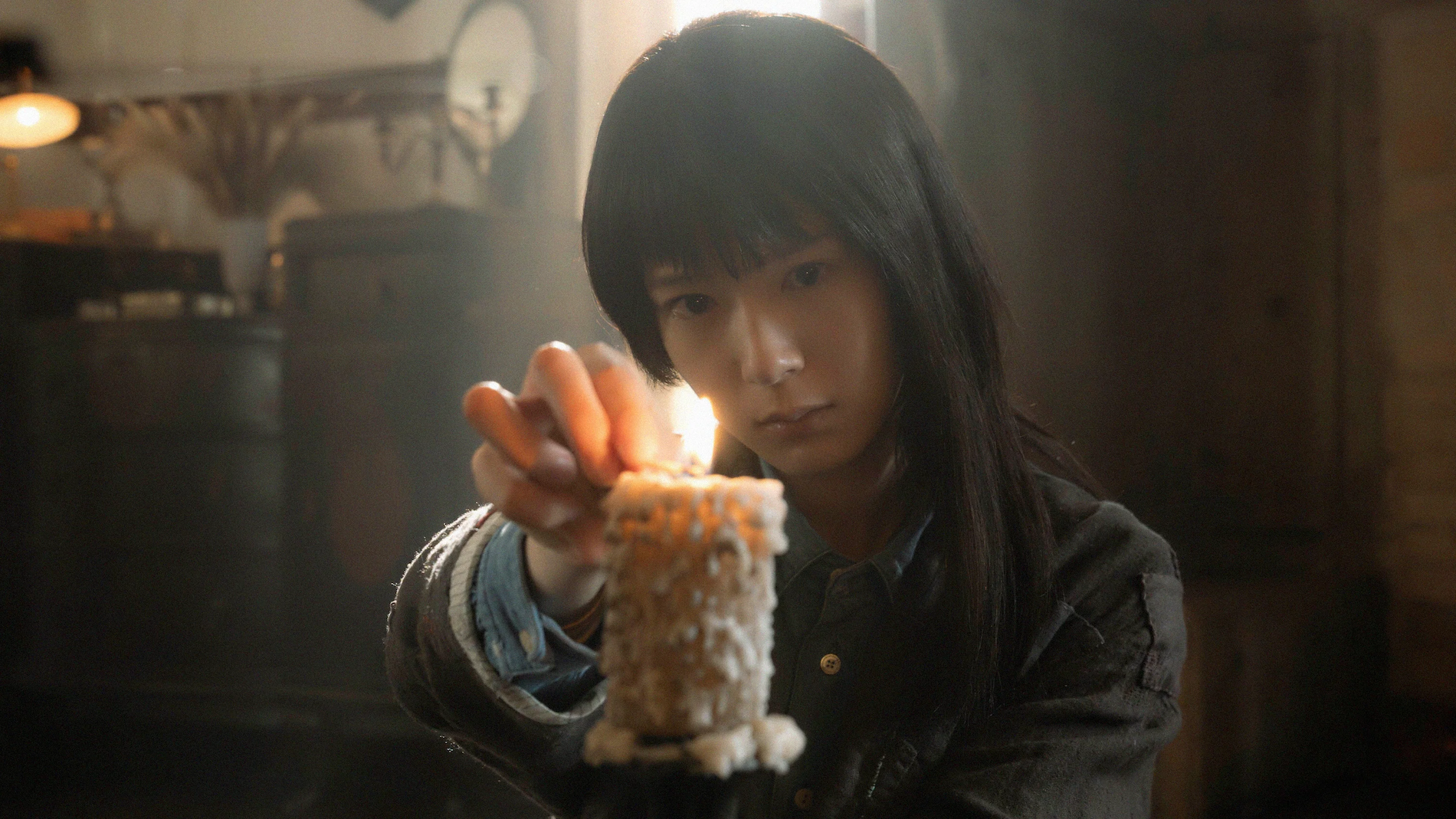
This is a movie that takes place largely in the flicker of candlelight, with hallways that were eerie enough during the day now filled with shadows and the horrors conjured by the viewer’s imagination. Ours may not be as powerful as Airi’s, but we’ll be just as terrified as she is before the candle burns out.