Issue
111
Fjord
- Director:Cristian Mungiu|
- Screenwriter:Cristian Mungiu|
- Distributor:Neon|
- Year:2026
The family that prays together stays together, except when it doesn’t.
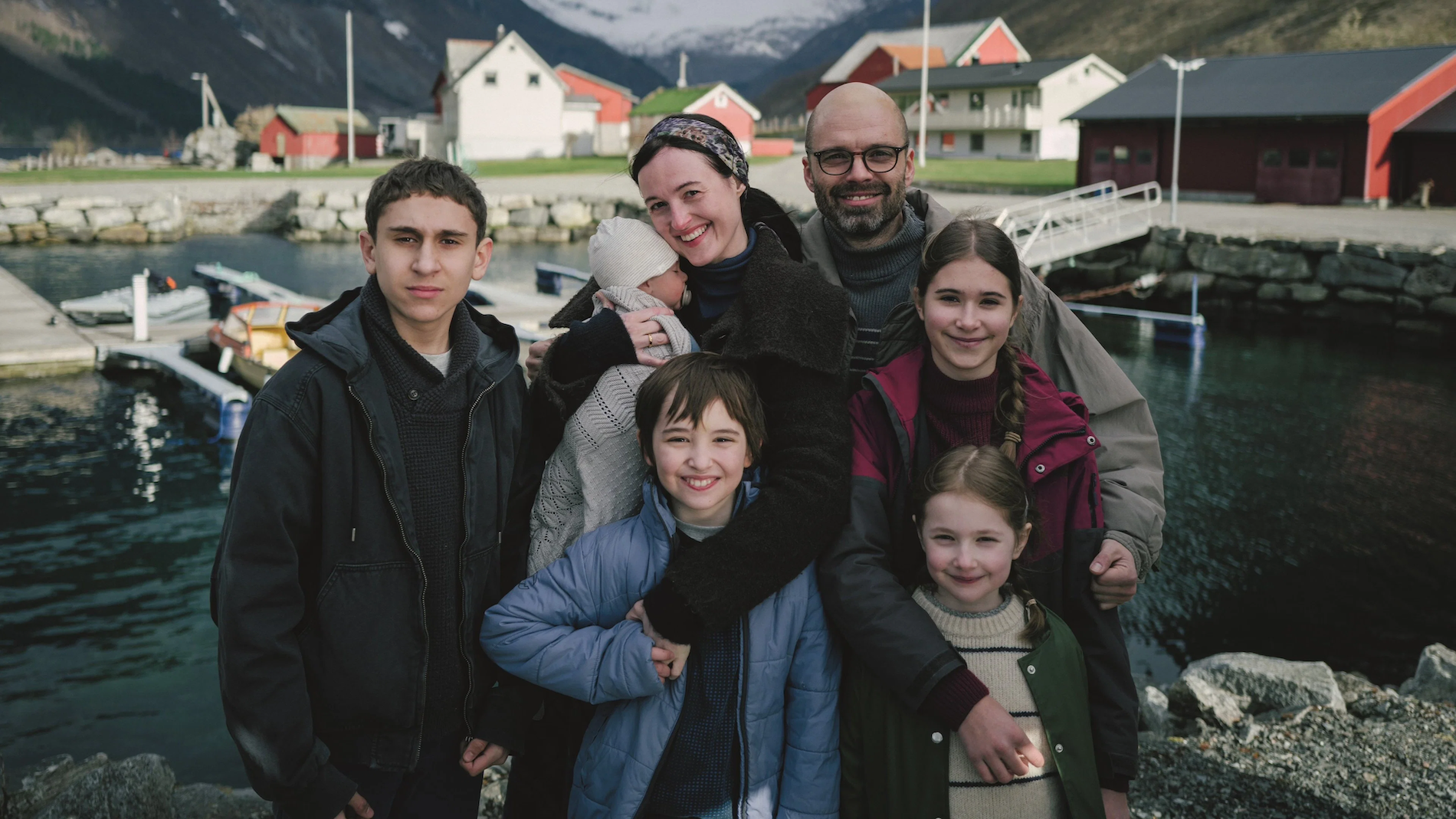
In Fjord, Romanian writer/director Cristian Mungiu leaves it to us to decide whether it’s precisely because the Gheorghiu family prays together that they’re separated by the authorities shortly after settling in a remote, arrestingly beautiful region of Norway. The literal and figurative trial of the Romanian-Norwegian clan — father Mihai (Sebastian Stan), mother Lisbet (Renate Reinsve), and their five children — is inspired by a true story, with Mungiu once again acquitting himself well as one of his country’s, and generation’s, most gifted filmmakers.
The family’s new neighbors are nothing if not neighborly at first, welcoming teenaged Elia (Vanessa Ceban) and Emmanuel (Jonathan Ciprian Breazu) to their new school and Mihai, a Romanian married to a Norwegian, to his municipal IT job with open arms. The devout Christians aren’t entirely at home among their adoptive community, however, with Mihai wearing his evangelical heart on his sleeve in ways that run afoul of the unnamed village’s insistence on keeping such matters private. Even so, no one minds too much — at least until they begin to suspect that Elia, Emmanuel, and their three younger siblings are being abused. Social services quickly remove all five children from the home pending an investigation that’s both a by-the-books legal proceeding and an extended public shaming that even self-proclaimed heathens might find excessive.
Having already earned a Golden Globe for his performance in A Different Man and an Oscar nomination for playing Donald Trump in The Apprentice, Stan is quietly amassing the most impressive post-Marvel resume of any of his fellow Avengers. Fjord is a homecoming of sorts for the 44-year-old, who was born in Romania and left the country under turbulent circumstances when he was eight. Bald and bespectacled, Mihai isn’t always the most sympathetic protagonist: a taciturn disciplinarian who stubbornly refuses to follow Norway’s unwritten rules and assimilate, he makes no apologies for his rough-around-the-edges personality. He also clearly loves his wife and children, but does he express that love in a socially acceptable way?
Mungiu, the first Romanian to win the Palme d’Or, joined even more rarefied air earlier this year when he took home the prize for the second time — something only nine others have done. That accolade alone makes Fjord a must-see, even if it’s only to argue about whether it was deserved. The writer/director is a chronicler of systemic corruption, ossified bureaucracy, and other societal forces that slowly crush his protagonists under their oppressive weight. In the past that’s come in the form of communist-era abortion bans (4 Months, 3 Weeks and 2 Days) and Eastern Orthodox convents (Beyond the Hills) in his native country, whereas Fjord takes on the opposite end of the political spectrum: liberal secularism that’s increasingly intolerant of views it deems intolerant.
It also takes place far from Romania. Whatever it might have to say about Norway’s politics, Fjord could double as a feature-length ad campaign for the country’s tourism industry. The backdrops are consistently stunning, especially once winter arrives in full and snow blankets nearly every scene — including one in which an apparently routine avalanche proves only a minor inconvenience Natural disasters are little more than a nuisance here, but disruptions to the carefully maintained social order are seismic events.
He clearly loves his wife and children, but does he express that love in a socially acceptable way?
A master of the slow burn, Mungiu builds tension gradually, then suddenly. Mihai idly plays a religious song on a school piano in one scene, Elia’s teacher notices a bruise on her arm in another. Asked whether they ever receive physical punishment for skipping Bible study, the girl’s answer is unintentionally damning: “Define physical.” But are these children being abused, or does the newly arrived family merely adhere to a stricter moral code than their ultra-secular neighbors? Mungiu raises this and other questions — the most crucial of which is when and how Elia got those bruises — not to provide easy (or even definitive) answers but to see how his characters and viewers respond to them being asked in the first place.
All of which is to say that, far from a conventionally satisfying legal thriller, Fjord is a detailed procedural that stubbornly refuses a-ha moments and witness-stand histrionics. Mungiu is so masterfully withholding, so skilled at not giving us what we’re used to getting from movies like this, that at a certain point you have to respect his dedicated restraint. A crowd-pleaser he is not, but a sharp-eyed observer — and, on the rare occasion he deems appropriate, diagnoser — of societal ills he most certainly is. Mungiu’s movies move at a pace resembling real life and rarely offer catharsis, with Fjord clocking in at 146 minutes of difficult conversations and personal reckonings.
The film is more than a mere act of both-sides centrism drawing on false equivalences, though. When asked how she would like living in a more conservative country in an attempted gotcha moment, Mihai and Lisbet’s attorney (Lisa Carlehed) defiantly responds that she would defend the minority no matter where she lived or what that minority believed. Fjord thus reveals itself as being more about the tyranny of the majority than the particular viewpoint that happens to hold that position at any given point, though focusing on a progressive worldview certainly distinguishes it from Mungiu’s prior work. If that happens to produce discomfort among viewers who thought they had him and his views pegged down, all the better.