Issue
104
It Ends
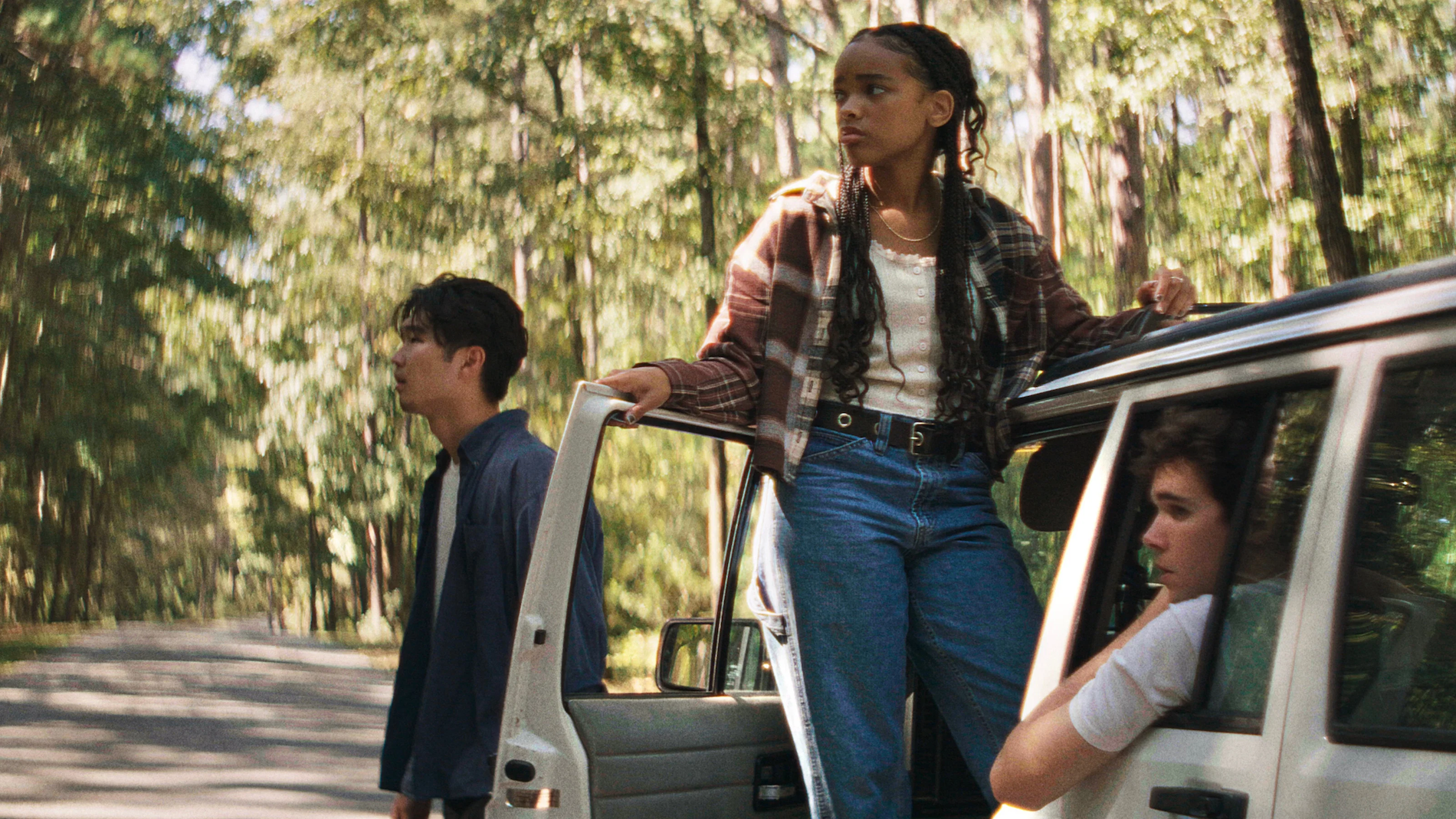
- Director:Alexander Ullom|
- Screenwriter:Alexander Ullom|
- Distributor:Neon|
- Year:2025
Or maybe it doesn’t.
Anyone who believes the journey is more important than the destination will have the strength of their convictions tested by It Ends, an existential road trip in which the destination may or may not ever arrive. The film follows four close friends — three recent graduates and a fourth whom the others haven’t seen in a year — on a last-hurrah drive to, it turns out, nowhere: after turning onto a forested road in the opening scene, the quartet quickly realize the turn they were supposed to take simply isn’t there.
Writer/director/editor Alexander Ullom’s debut feature forms a recursive loop alongside Exit 8 and Backrooms in its portrayal of a uniquely nightmarish dread: the growing awareness that the liminal space you’re in appears to go on forever with no offramp in sight. It can’t be real, because how could it, and yet it is. It Ends isn’t exactly a horror movie, with few overt scares to speak of, but it’s also not not a horror movie — a kind of waking dream its characters keep expecting to wake from but never do.
Tyler (Mitchell Cole), who’s behind the wheel, notices first — not that anyone believes him. James (Phinehas Yoon), in the passenger seat, insists that Tyler must have missed it, while Day (Akira Jackson) and Fish (Noah Toth) are too distracted in the backseat to have a strong opinion. The dialogue in these opening moments is distinctly Gen Z, beginning with an argument over picking two of the following to defend you from the other two: a gorilla, 50 hawks, 10,000 rats, and a guy with a gun. (For the record, hawks and rats to defend.)
The debate that follows will feel authentic to anyone who’s ever discussed just this kind of low-stakes thought experiment with their friends, whether in a car or a dorm room. Is the guy with a gun especially skilled with said firearm, for instance, or is just an everyman who happens to have a hunting rifle? Tyler couldn’t care less about the discussion, leading to a revealing question from James: “Do you no longer greet the day with glee, Tyler? Does your spirit no longer yearn for adventure?” Tyler focuses on driving and turns around instead of answering, only to find that what should be the beginning of the road they’re on is now a dead end.
Then a mob of screaming people emerges from the forest.
It Ends isn’t exactly a horror movie, but it’s also not not a horror movie.
James thinks they might be dead and this is all the afterlife has to offer: a never-ending road stretching out infinitely in front of them, torturing them with the possibility that it might eventually lead to something. It sounds like hell or maybe limbo, though none of them are up to date on their eschatology. They don’t get hungry or tired, the car doesn’t run out of gas, and none of them can understand why — let alone believe — this is happening. “Do you guys think we deserve this?” one of them asks.
Like a lot of promising first-time filmmakers, Ullom does a lot with a little. The entirety of It Ends takes place in or just outside an SUV, with the unwritten rules dictating that the group has 90 seconds to stretch their legs before the forest people emerge. Ullom’s script is talky and tangential, with Tyler, James, Day, and Fish bemoaning their fate as they try to make the most of it. Anyone who’s never seen the appeal of the open road will surely sympathize, especially as an odometer occasionally appears onscreen to show how long the drive has gone on: 50,000 miles when at the end of the first act, then 800,000, and finally over 1,000,000 as the movie nears its end.
Their purgatorial ordeal speaks to the banality of survival, of merely existing rather than living, and makes passengers of them all. It’s a difference that some are more willing to grapple with than others. James is the most analytical of the bunch, as well as the most inclined to believe — or least hope — that there’s some meaning to all this and the road might have an end. One must imagine Sisyphus happy, after all, and if you can’t find meaning you can still create it.