Issue
108
The History of Concrete
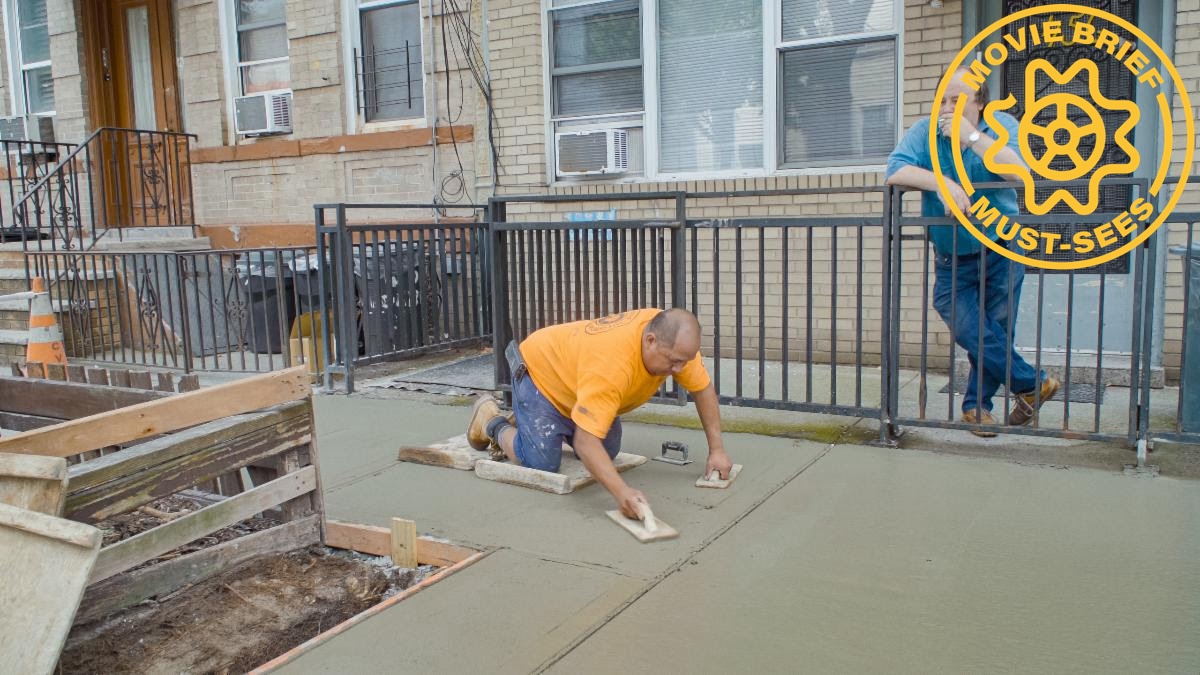
- Director:John Wilson|
- Screenwriter:John Wilson|
- Distributor:Magnolia Pictures|
- Year:2026
Concrete lasts a long time, but not forever.
That’s worth pondering for a moment. One of the most enduring materials ever created by human hands is ultimately impermanent, which is another way of saying that everything we’ve created is impermanent. Nothing beside remains indeed, especially since the sand that stretches out past the pedestal may one day be mixed with cement and begin the process anew.
Concrete itself might not be beautiful, but it can be used to create things that are — including, apparently, documentaries. John Wilson is among the greatest observers in contemporary cinema, a filmmaker with such a keen eye for the overlooked that he’s also a kind of poet and philosopher. The History of Concrete is about a lot of things, but the history of concrete isn’t really one of them. Concrete itself, yes: its applications, its ubiquity, its meanings. But its origins are barely mentioned by Wilson, who’s ultimately more concerned with its — and our — future.
The first-time filmmaker, a small-screen veteran whose nasal, second-person narration accompanies nearly every frame of his work, has made a career of luring in viewers with deceptively simple premises that, in his framing, become launching points for quietly profound statements on pretty much everything. If you haven’t seen How To With John Wilson, his excellent HBO docuseries with episode titles like “How To Put Up Scaffolding” and “How To Remember Your Dreams,” it’s difficult to describe just how many hours of B-roll he’s filmed and how cleverly he edits it into something vastly more than the sum of its parts.
Wilson has spent countless hours walking the streets of New York and fashioning the countless blink-and-you’ll-miss-it oddities he happens upon into poignant, frequently laugh-out-loud assemblages. “If anyone can re-create a voice,” he muses over footage of a woman walking her dog in front of a mural of a woman walking her dog, “then what value does the original have?” Elsewhere he’s more understated, but the cumulative effect is no less thought-provoking when he isn’t working in an overtly philosophical register.
Now that he’s a minor celebrity, he’s only grown more self-effacing: The History of Concrete features a Jeopardy! clip in which none of the contestants can identify him as the host of “an HBO show that teaches you how to do things” as well as a close-up of a $0.49 royalty check he received for his work on the acclaimed program. In search of a new project, he eventually settled on one that’s partially about its own creation. Wilson humorously details the many Zoom meetings that went into financing a documentary about a decidedly unsexy topic with limited financial prospects, admitting at one point that “it’s kind of hard to, um, get people excited about concrete, I’m finding.” Good thing that changed. The History of Concrete premiered at Sundance to rave reviews and is now arriving in theaters courtesy of Magnolia Pictures, which was apparently — and thankfully — excited about concrete.
It’s unlikely that any of us have considered the implications of this topic as extensively as Wilson, though even he admits to being far from an expert on the second-most widely used material on the planet after water. “It’s embarrassing to know so little about something that occupies so much about your visual environment,” he cites as one reason for pursuing the project, and he’s not wrong. Anyone who mourned the fact that How To ended after just three seasons will be delighted to learn that The History of Concrete is not unlike a feature-length episode of that gone-too-soon program, its one-of-a-kind sensibility fully intact and undiluted when expanded to feature length.
Concrete itself might not be beautiful, but it can be used to create things that are — including, apparently, documentaries
Among the digressions this time around are Hallmark Movies, chewing gum, a 3,100-mile race taking place over 52 consecutive days in New York, and a musician named Jack Macco whom Wilson initially meets giving out free samples at a liquor store. The filmmaker then attends one of his gigs and interviews him several more times, including after Macco’s longtime fiancée passes away after a brief, sudden illness. That the most memorable, melancholy aspect of the entire film came after a chance encounter is emblematic of everything that makes Wilson’s approach so special.
For as discursive as all this sounds, The History of Concrete isn’t simply meandering from one topic to another without ever arriving at a point. Wilson is a master at interweaving and resolving the seemingly disparate threads he introduces, often to hilarious effect; there even also unwitting cameos from Kim Kardashian, Tom Ford, and, most excitingly, Tim Robinson, whose sense of humor is on the same offbeat end of the spectrum as Wilson’s.
The History of Concrete is free-associative to the nth degree. A trek to Ohio to see the oldest concrete street in America turns into a ride-along with a driving school whose students drive on said street, which leads to a graphic safety video shown to teenagers, which leads to an interview with a widow who framed a portion of her husband’s tattooed skin after he died in a motorcycle accident, which turns into a visit with the founder of the company that preserves his and other dead people’s tattoos, whose grandfather was the mortician who embalmed Chef Boyardee, whom Wilson didn’t realize was a real person. What does any of this have to do with concrete? You’ll have to wait until the brilliant last shot for the answer, by which time you’ll have learned about a lot more than just concrete.