Issue
112
You Can See Everything
- Director:Nathan Fielder, Lance Oppenheim|
- Screenwriter:Nathan Fielder, Lance Oppenheim|
- Distributor:A24|
- Year:2026
The irresistible force meets the immovable object in You Can See Everything, a brilliant, potentially era-defining film that suggests Nathan Fielder has finally met his match.
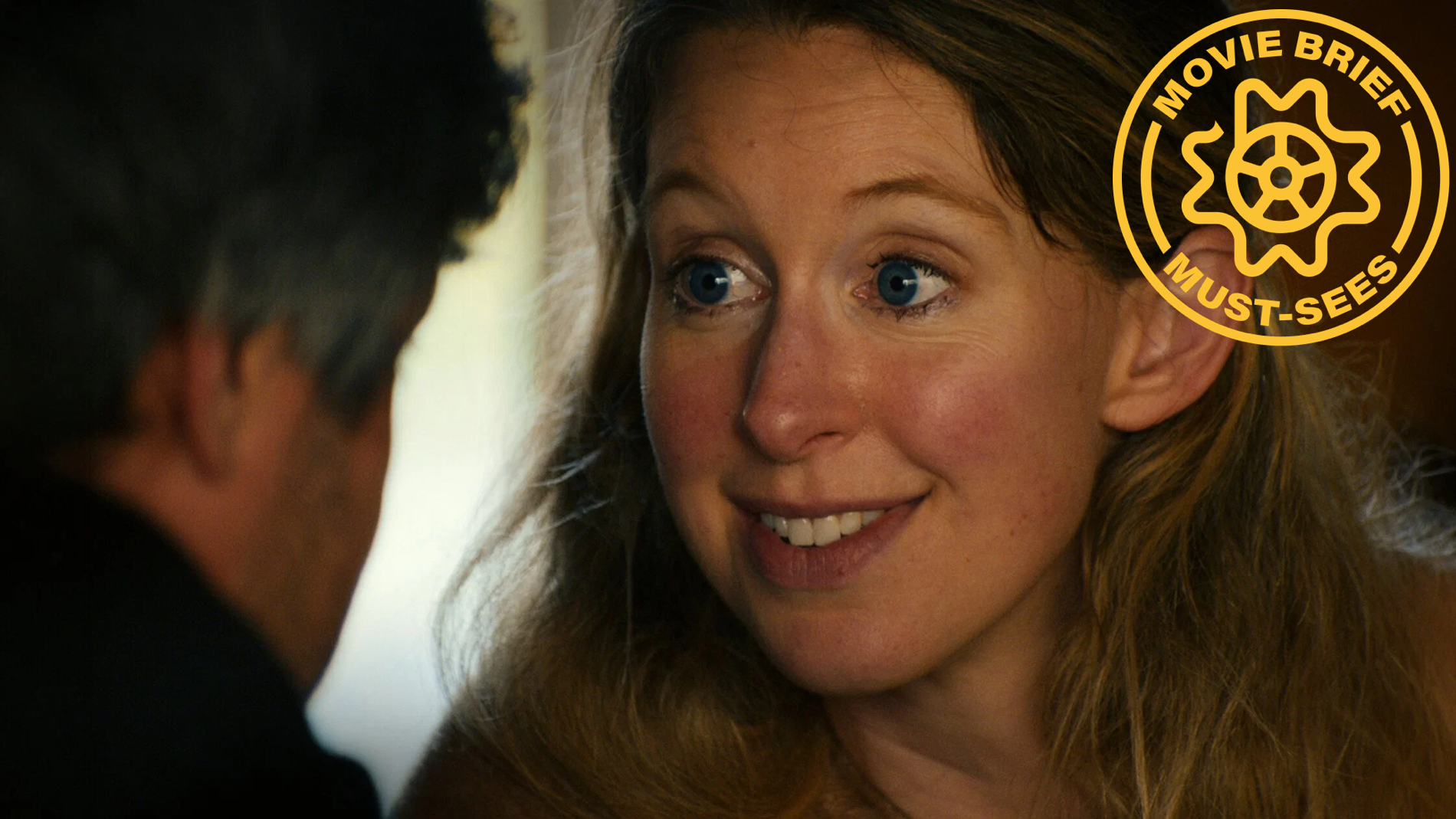
The cringe-comedy maestro, who’s built a career on staying in character as he places his unwitting subjects in hilariously uncomfortable situations, broke the internet last month when it was revealed that he and co-director Lance Oppenheim (Primetime) had spent the last three years working on a secret documentary about Elizabeth Holmes. For reasons not even Fielder can articulate, the disgraced Theranos founder and her husband, Billy Evans, allowed him to film her final 34 days of freedom before she began an 11-year prison sentence for defrauding investors. He went so far as to stay at their San Diego rental home during production, but at no point in You Can See Everything does he elicit the kind of embarrassing or even damning reaction that has become his calling card.
Anyone familiar with Fielder’s prior work, especially his breakout Comedy Central show Nathan for You and the increasingly ambitious HBO series The Rehearsal, will be unsurprised to learn that Holmes and Evans were only passingly familiar with his resume. Had they had seen a single episode in its entirety, it’s hard to imagine they would have not only willingly subjected themselves to his antics but given him unfettered access to their most intimate moments. What unfolds over the film’s riveting three hours is like a cinematic game of cat and mouse in which we slowly come to understand that Fielder and Holmes are both the cat, or maybe the mouse, or maybe some newly discovered species that’s fascinating to observe but impossible to pin down.
“In absence of knowing somebody,” Evans says early on, “it’s really important to make them feel other — and scary.” He considers their participation in the documentary an act of “radical transparency” that allows people to see his apparently misunderstood wife as she really is, not as she’s been portrayed. Her husky voice and piercing gaze certainly lend themselves to caricature, as does the tabloid-ready nature of the billion-dollar transgressions that landed her in federal prison. She isn’t wrong that millions of people have already made up their mind about her based on limited — if entirely accurate — information.
That includes The Dropout, a Hulu miniseries starring Amanda Seyfried that takes on an outsize role in You Can See Everything’s second half. “They’re not playing me,” Holmes is quoted as saying in an interview whose accuracy she questions, “they’re playing a character I created.” Fielder, too, is presumed to be playing a character much of the time we see him in his own projects: painfully awkward, oblivious to social cues, and utterly unafraid of asking questions that most others would never dare. His approach has raised ethical concerns from some critics, even the fiercest of whom still readily admit that the results are consistently hilarious.
Holmes almost immediately proves to be Fielder’s most compelling subject yet, largely because she’s either unwilling or unable to admit that she did anything wrong when she claimed that Theranos’ supposedly groundbreaking device could perform all manner of rapid, highly accurate tests using a single drop of blood. A master of deflection and obfuscation, she never gets defensive or loses her composure as she attempts to explain how and why everything she’s said is truthful. To get her to understand his perspective, an exasperated Fielder plays Abbott and Costello’s legendary “Who’s on First?” and asks her perhaps the most important question of the entire film: “Do you understand why that’s funny?”
She does not. At all. Holmes’ mind appears to work on such a literal level that she genuinely can’t comprehend the wordplay that makes “Who’s on First?” so timelessly clever, which might explain why she so ardently believes it’s true that her device “can” perform all those tests if and when the underlying chemistry catches up to its own capabilities. (Had her attorney performed this stunt in court, it honestly might have helped her case.) “All I know is my truth,” she insists, which turns into the film’s overarching project: how to know if and when another person is telling the truth when all evidence points to the contrary.
Despite being one of the most notorious liars in recent memory, Holmes nevertheless emerges as, if not exactly a sympathetic figure, then certainly not the villain of the film. That would be her endlessly devoted husband, who trusts her implicitly but also seems to be manipulating her far more than Fielder ever could. Evans comes across infinitely worse than his better half, in part because he’s more intentional and calculating in everything he says and does. It’s he who demands that Fielder turns off the camera during uncomfortable situations and appears to have ulterior motives in agreeing to be filmed in the first place, not her. It’s possible to believe that Holmes is somehow deluded enough to believe her own lies, but the more we see of Evans the more it feels as though his name should be as synonymous with deceit as hers.
Holmes almost immediately proves to be Fielder’s most compelling subject yet, largely because she’s either unwilling or unable to admit that she did anything wrong.
All of this is edge-of-your-seat thrilling in and of itself. It’s also only the first half of the film, which transforms into something like the third season of The Rehearsal once Holmes reports to prison and Fielder can no longer meet with her in person. Two well-known actors whose identity shan’t be revealed here step in to help the filmmakers reenact Fielder’s meetings with Holmes and Evans that, for one logistical reason or another, were never recorded. Because they’re based on his recollections, however, we have to take Fielder at his word that he’s portraying these encounters truthfully and accurately. But he was an entertainer for years before he was a documentary filmmaker, and isn’t it entirely plausible that he has just as much reason to embellish certain details as Holmes, even if his reasons for doing so are completely different? If it’s true that she’s a manipulator, Fielder implicitly concedes, it’s also true that it takes one to know one.
As one layer of artifice is laid atop another, the true scope of You Can See Everything’s formal and analytical ambition comes into focus. The interplay between subject and creator make it nigh impossible to glean where truth ends and lies begin — and, thanks in no small part to the fact that cinematographer David Bolen shoots it like a psychological thriller, the film is all the more gripping for it. “I believe her,” the actress Fielder brings in to play Holmes in those reenactments eventually admits, “I don’t know why.” By the end of it, you might too.
A brilliant deconstruction of the subjective, ultimately unknowable nature of truth both onscreen and in real life, You Can See Everything confirms Fielder as not only a comedic genius but a probing observer of human nature in all its thorniness. It’s both the cinematic event of the year and the apotheosis of its co-director’s career thus far, an almost Rashomon-like meditation on what we believe, what’s actually true, and the intersection of the two. The more Fielder tries to understand Holmes, the more unknowable she becomes. Just because we can see everything doesn’t mean we can make sense of it.