Issue
113
Fatherland
- Director:Paweł Pawlikowski|
- Screenwriter:Paweł Pawlikowski, Hendrik Handloegten|
- Distributor:Mubi|
- Year:2026
Some countries are mothers, and some are fathers.
Anyone who’s ever said “Mother Russia” in an exaggerated accent knows that maternal personifications tend to be more common, as do those who remember that Columbia preceded Lady Liberty as the feminine embodiment of America. Germany, meanwhile, is a fatherland, which was particularly true when Hitler weaponized the concept of the Vaterland during the 12 years he was in power: iron-fisted, militaristic, and unfathomably destructive. In Paweł Pawlikowski’s Fatherland, the third and final entry in a trilogy exploring different corners of postwar Europe, it’s at a crossroads that its two lead characters are reluctant to traverse.
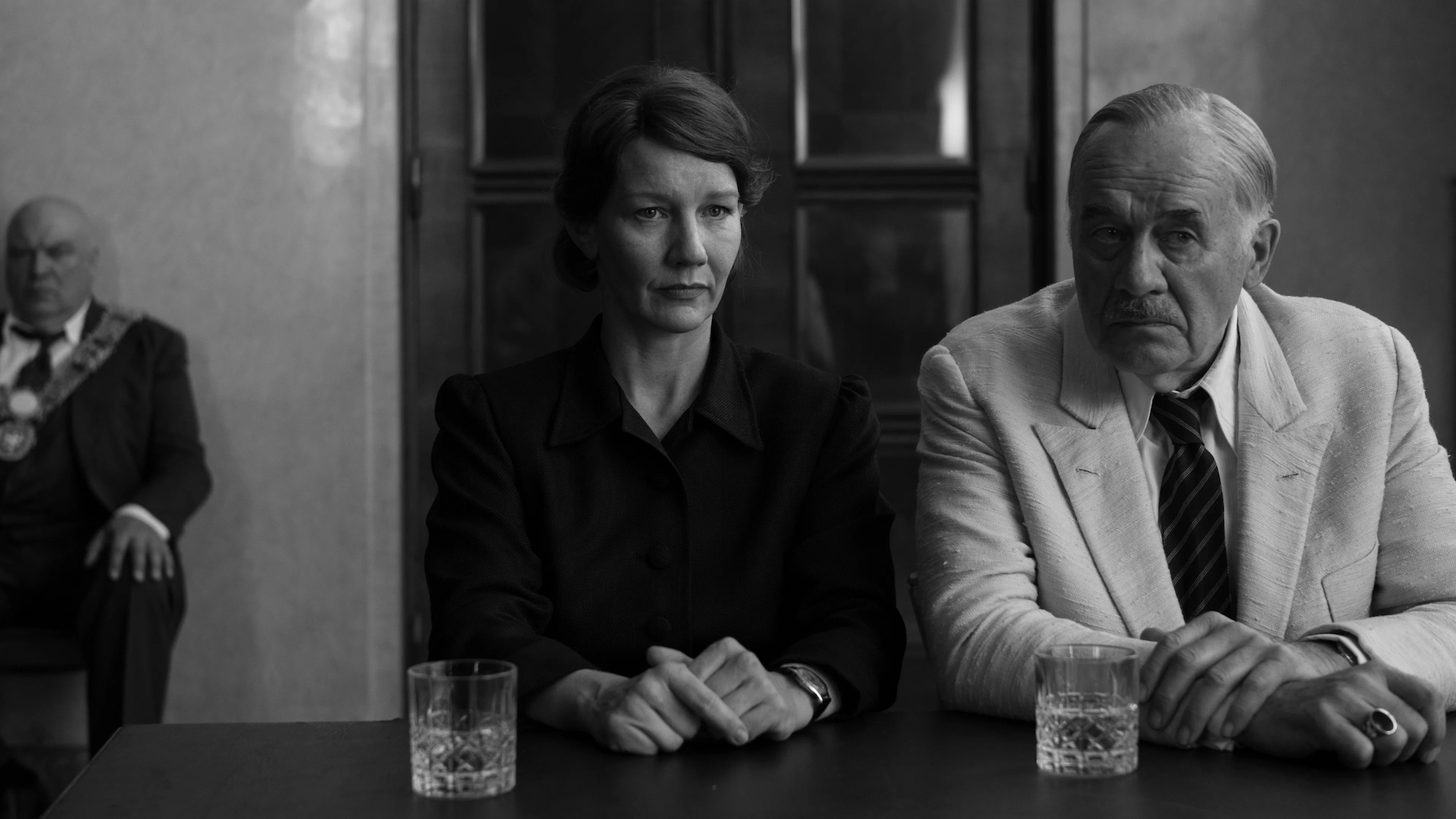
Starring Hanns Zischler as Nobel Prize–winning author Thomas Mann and Sandra Hüller as his daughter Erika, the film is set in 1949: the year Mann returned to Germany to receive a prestigious award after 16 years in exile. But sometimes you really can’t go home again, especially when it’s been ravaged by the most devastating war in human history and no one can agree on what it should look like moving forward. “You have to say what side you are on: Stalin or Mickey Mouse,” Erika’s morose brother Klaus (August Diehl) says in the opening scene. At a scant 82 minutes, Fatherland manages to be both a poignant rumination on what makes a country a country and a father-daughter road-trip drama.
Thomas and Erika experience a kind of reverse culture shock at the reception for his prize, which precedes their drive from West to East Germany — a journey that takes them across more than just a physical border. Among those at the ceremony hoping to be welcomed back into polite society are the two grandsons of Richard Wagner, whose music proved to be a clarion call for the Third Reich, and an actor who may or may not have been instrumental in banning a novel written by Klaus. Thomas and Erika, who fled the country in 1933, are unmoved by their entreaties: “There are many things one can do without selling one’s soul,” she tells that actor, whom it’s soon revealed is her Nazi collaborator of an ex-husband. She ends their conversation with a slap that everyone in the crowded room sees and no one objects to, at least openly.
For as singular a year as The Odyssey and Primetime’s Robert Pattinson is having, it’s Hüller who seems most likely to be remembered as the actor who defined 2026. After earning steady acclaim in arthouse circles for her roles in German films like Requiem and Toni Erdmann, she finally received her long-overdue flowers at the international level when she starred in two of 2023’s most acclaimed movies: Anatomy of a Fall and The Zone of Interest, earning her first Academy Award nomination for the former. Nevertheless, 2026 feels like even more of an annus mirabilis, with her performance as Erika serving as a reminder of her unique ability to infuse nuance and melancholy into the smallest expressions. (She even has an outside chance of making Oscar history by landing nominations for Project Hail Mary, Fatherland, and the upcoming Rose, which already landed her a Silver Bear at the Berlin Film Festival.)
It helps that her skills and Pawlikowski’s are so in sync. He’s now among the most lauded filmmakers ever to emerge from Poland, having won the Academy Award for Best Foreign Language Film for Ida (2013) in addition to Best Director laurels at Cannes for both Cold War (2018) and now Fatherland; Cold War was also nominated for Best Foreign Language Film, Director, and Cinematography at the Oscars. Anyone who’s seen those prior two films will immediately recognize returning collaborator Łukasz Żal’s stark black-and-white cinematography, which lends heft and elegance to every frame. Though it can feel icy and withdrawn at times, Pawlikowski’s trilogy in general and Fatherland in particular is consistently stunning to behold.
Fatherland manages to be both a poignant rumination on what makes a country a country and a father-daughter road-trip drama.
A country is a concept as much as it is a collection of borders and people, and in the wake of World War II “New Germany” had to decide which high-minded ideals it wanted to embody. A clue comes in the lyrics to what one character proposes as a new national anthem, which is sung by a group of schoolchildren: “May both peace and joy inspire Germany, our fatherland / Peace is all the world’s desire / To the peoples lend your hand / In fraternity united we shall crush the People’s foe / Let all paths by peace be lighted / That no mother shall again spill tears over her son.”
Homes, government buildings, and cultural institutions can be rebuilt, but some ideals cannot. It isn’t just individuals who can have daddy issues, after all, and Fatherland makes it clear that reckoning with your country’s past is no less difficult than making peace with an unknowable parent. “Let’s go home,” Erika pleads at one point. Her father’s answer says it all: “Where is that?”