Issue
117
Paper Tiger

- Director:James Gray|
- Screenwriter:James Gray|
- Distributor:Neon|
- Year:2026
James Gray is your favorite director’s favorite director.
And though he’s always seemed more comfortable on the fringes of mainstream American cinema, Gray has once again made the case that he should be one of yours, too. Paper Tiger is made out of recognizable parts, especially for anyone familiar with Gray’s work. Like Little Odessa, it involves the Russian mob; like We Own the Night, it’s about two brothers whose relationship with each other is as complicated as their relationship with the law. Gray’s nuanced construction and a trio of solid performances from Adam Driver, Miles Teller, and Scarlett Johansson ensure that those pieces are assembled into something sincere, heartfelt, and yes, more than the sum of their parts.
Gray, whose sensibility is nearly as literary as it is cinematic, opens his latest with a quotation from Aeschylus: “Let there be wealth without tears; enough for the wise man who will ask no further.” That’s easier said than done for Gary (Driver) and Irwin (Teller) Pearl, brothers living in 1986 Queens whose financial woes lead them to an ill-advised proposition. Any movie in which potential business partners are referred to simply as “the Russians” tends to involve transactions that are shady at best and deadly at worst, a lesson that Irwin’s wife Hester (Johansson) and teenage sons learn the hard way one fateful night.
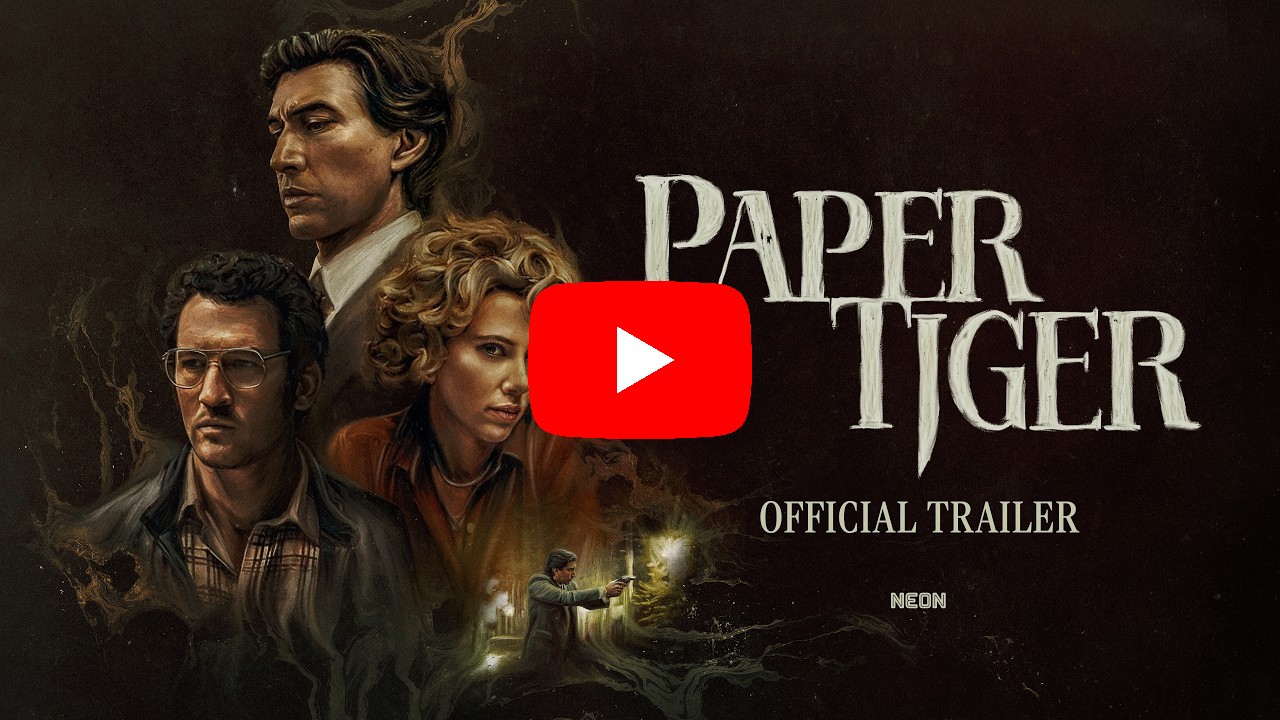
Like a lot of Gray’s movies, Paper Tiger is a New York City period piece whose characters belong to a certain social class but would very much like to belong to another — and aren’t always scrupulous about how they achieve it. Few chroniclers of the Big Apple evince the same degree of street smarts as the Queens native, whose family name of Grayevsky was shortened when his paternal grandparents arrived at Ellis Island and who has only made two films not set in New York: The Lost City of Z, which takes place in the Amazon, and Ad Astra, which takes place in space. The rest are situated in microneighborhoods and on streets that only true New Yawkers will know by name, lending a lived-in authenticity for locals and a certain exoticism for everyone else. There’s a world inside the world of every James Gray movie, and Paper Tiger is no exception.
Driver excels as the kind of charismatic, ne’er-do-well uncle who invites himself over to dinner because he doesn’t have a family of his own but does have important news that shouldn’t be shared over the phone. The kids adore him, his brother secretly worries he’s not doing as well as he says he is, and even Hester is impressed by his card tricks. (Only the boys ask to see his service resolver once their parents have left the room, though.) He’s a charmer, but you get the sense that this isn’t the first time he’s approached his brother with what he assures him is a good deal. A retired police officer, he carries himself in a way that suggests a certain blue line isn’t thin so much as porous.
Gray has been quietly amassing one of the most impressive filmographies of his generation over the last 30 years, though he’s never enjoyed the same commercial success as contemporaries like Paul Thomas Anderson and David Fincher. There are maybe a dozen movies released in the last 15 years more moving and accomplished than The Immigrant, which stars Marion Cotillard as a Polish immigrant who arrives in New York in 1921, not that you’d know it from the film’s muted box-office reception. If it’s disappointing that Gray’s movies never set the multiplex ablaze, it’s also encouraging that this hasn’t prevented him from continuing to make movies his way.
There’s a world inside the world of every James Gray movie, and Paper Tiger is no exception.
Perhaps the most memorable line in his entire filmography comes near the end of the criminally underrated We Own the Night, which had the misfortune of bearing a superficial resemblance to The Departed and being released less than a year later. “I love you very much,” a police officer played by Mark Wahlberg tells his drug-dealing brother (Joaquin Phoenix), who responds that he loves him too. That quiet moment has echoed throughout Gray’s subsequent work, not only for its surprising tenderness but also for how much it applies to other relationships. Gray based Jeremy Strong and Anne Hathaway’s Armageddon Time characters on his own parents, and Gary and Irwin have more than a little in common with the brothers played by Wahlberg and Phoenix. You don’t need to have seen either movie to appreciate Paper Tiger’s slow-burning thrills, but Gray’s movies are in conversation with one another in a rich, increasingly expansive way.
Paper Tiger has two unforgettable scenes of its own, although they’re more terrifying than tender. In the first, Irwin awakens to the sound of men in his house after a well-intentioned misunderstanding puts his new partnership at risk. He’s able to scare them off with the help of a firearm, but once he does he finds that the furniture has been rearranged and the intruders have left behind polaroids of him, his wife, and their two sons asleep in their beds. In the second, Gary puts it all on the line with nothing more than a pistol and the little cover provided by tall grass and the occasional sound of planes taking off from a nearby airport. The brothers couldn’t be less alike in their initial response to their increasingly dire circumstances, with Irwin fearful for his family and Gary defiant in the face of everything the Russians have thrown at them, but when the cards are down both are concerned with little more than protecting their loved ones.
“Maybe this will be what you wanted,” Hester says after learning that Irwin has been paid $10,000 upfront for merely consulting with the Russians and there’s much more on the way. Maybe, but probably not. Gray’s movies are about close-knit communities where attempts to improve one’s circumstances and pursue the American dream tend to result in rude awakenings. “This was a bad night,” Irwin tells his kids the morning after their home is broken into. “Tomorrow will be better, I promise.” It’s hard to believe a promise like that in a James Gray movie, but it’s certainly nice to try.